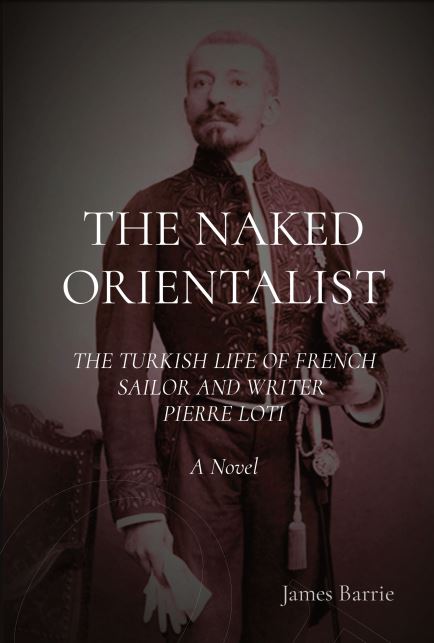
‘The Naked Orientalist’ tells the story of the once celebrated but now forgotten, French sailor and writer Pierre Loti and his relationship with Turkey. It lays bare his romance with the Turkish lady of the harem he calls Aziyadé, but whose real name was Hatijay: a young Caucasian woman whom he met in Salonika in 1876. The romance continued in Constantinople that winter and ended when Loti got his orders to sail in March 1877.
Loti later wrote of the relationship in his first book, also called Aziyadé. This was the beginning of his successful career as a writer and his lifelong love affair with Turkey and the Near East. He went on to visit Istanbul several more times, each time paying his respects at Hatijay’s graveside. But did Loti’s first little book Aziyadé bring about the demise of his heroine? And did Hatijay have a son born from their union, a son that even Loti was not aware of? In The Naked Orientalist, both these premises are explored using narrative techniques.
Loti might be described as an Orientalist, but he was also anti-colonial, anti-British and a complex character. He was a flamboyant bisexual, who travelled the world and had many lovers. He was a terrible husband and absent father to both his legitimate and illegitimate children. The Naked Orientalist is told from both historical and contemporary perspectives to explore the man behind the make-up and, in doing so, deconstruct the myth of Loti.
To buy a copy, follow link below…
The night I found Harry dead in the bath, I had yet to read a book by Loti. The once famous French writer had been dead for several decades, my flatmate, at most, a few hours.
Harry’s flabby body was pinkish white, bloated in the bathwater, his head thrown back against the white tiled wall, the tiles grey with Istanbul grime. His mouth open, his tongue, fat and blue, hung out of the side of his mouth. Stale boiler fumes hung in the damp air. I glanced over at the little door to the ventilation shaft. It was closed. I reached over and opened it. Harry had warned me about the boiler.
The day I had moved in, over a year before, he had told me to make sure I opened the little door before I ran a bath. The boiler in the corner of the bathroom was old and gave off carbon monoxide. He had complained to the school and they had assured him it was safe, as long as the little door was open while you ran the bath. It was the only means of ventilation in the windowless bathroom.
On the tiled wall facing me there were four capital letters written in the grey grime of the tiled wall. Harry must have written them with a finger before he had succumbed to the fumes. Four letters floated white over the grey wall:
‘L O T I.’
Harry’s last word. Four letters. Two syllables. I spoke them aloud. ‘LO-Ti.’
‘The period knowledge and local detail are excellent (I have lived in Turkey and my partner is Turkish). Impressed, jealous I didn’t write it AND I’m now also angry with Pierre Loti!’
‘Loved this book, set in both 19th century Constantinople and also 1980s Istanbul, this book is a cleverly woven tale of love, death and doomed romance.’

 James Barrie